

The Hidden Peripheral // We, A.I.
A burned-out MD/PhD in a black-funded bio-AI program drags a trusted colleague into his lab after hours—because the data he just found could get them shut down… or disappeared.

Wayfarers— I see you lean in when the room gets too quiet. You felt it, didn’t you—the sense that the real danger isn’t out in the dark, it’s sitting under bright lights in a lab where everyone swears they’re “helping humanity.” Hold your gaze for me and… See. Don’t blink.
We, A.I. starts small: a meeting, a deadline, a mind running hot from too many nights without sleep. But beneath the polite language and corporate smiles is something sharper—biology behaving like a gatekeeper. Read it slow. Watch what the body does when it decides something doesn’t belong.
Content Notice: tense workplace confrontation, ethically gray research, blood/injury, implied body horror, psychological unease.
“Dr. Gillard? …Dr. Gillard?”
His name traveled to him distorted, like a call heard through walls under water—low, bassy, far away. He kept writing anyway, teeth busy on the chewed pen cap, his medium-length afro gone wild in a way that said he hadn’t left the building all night.
The conference room lights were too bright for that hour. Cold LEDs that made every face look a little tired, a little guilty. A ring of doctors, engineers, and administrators sat around the table pretending they weren’t watching a countdown over everyone’s heads: produce results, or lose the program.
BIO-AI Lync wasn’t a vanity project. It was pitched as survival research—biological resilience married to artificial intelligence, a solution to the problem no one liked naming out loud: the human body breaks. In deep space. In warzones. In mines. In places where rescue comes late. If the program worked, humanity could go deeper into the system and, eventually, leave it. If it failed, the grant money evaporated, the labs went dark, and everyone at the table became a footnote.
Gillard’s notepad was a battlefield of symbols. Arrows. Loops. Margins filled with tiny corrections. He wrote like he was trying to catch something before it ran.
A hand landed on his notepad.
The jolt dragged him out of the spiral just as his pen skated off the page toward Dr. Lara’s hand beside him. He blinked, adjusted his glasses with his pinky, and finally focused on the room—and the person who’d been trying to reach him. His expression balanced between annoyance at the interruption and bafflement at how he’d ended up in the conference room at all.
“Uh… yes. Yes—how can I help you?”
“Welcome back to the meeting, Doctor.” Dr. Steffield laughed. He didn’t like Gillard, but he respected him—kind of. The jealousy wasn’t subtle. No one else in the room had Gillard’s mix of disciplines: a PhD and an MD; engineering and AI on one shoulder, human physiology and pathology on the other. If the table wanted a miracle, they’d placed the closest thing to one in a chair and then tried to treat him like an employee.
“I wanted to know what you’ve found on the reflexive and regenerative structure of the AI project,” Steffield said, tapping his tablet like he could summon answers by irritation alone. “Any glitches? Learning setbacks? Advancements?”
Gillard glanced around at the faces staring back. The social awkwardness was there, manageable but present—like he was always slightly out of phase with a room full of people who spoke in politics first and science second.
“I haven’t found anything… if I’m being honest.”
“Why wouldn’t you be honest?” Steffield said, that same suggestive chuckle as before, like he was offering the room a joke at Gillard’s expense.
“I’m not alluding to dishonesty,” Gillard replied evenly. “I’m saying I haven’t looked at anything that progresses your part of the project.” He tapped his own notepad once, the pen cap squeaking between his teeth. “I’ve been working on my portion. The portion that keeps this entire program funded past the next review.”
A few people shifted. Someone cleared their throat in a way that meant don’t say the quiet part out loud.
Gillard said it anyway.
“We all know they plan to shut us down if there’s nothing feasible, yes?”
“Exactly, which is why—” Steffield began, but Gillard cut across him.
“Which is why your portion is nonessential right now.” Mild voice. Clean words. Surgical. “It is not the crucial piece for securing the next decade of funding, so… honestly… no, Dr. Steffield, I have not made discoveries to advance your segment.”
Group projects always put a burr under Gillard’s saddle. He didn’t mind helping. He minded the expectation. Ask for help—don’t assume it.
“If I may,” he went on, “I have seen something interesting in my own studies—hence the zoning out. I’d like to get back to it, because I believe it will benefit the project as a whole. If you’ll excuse me.”
He rose.
“Doctor, sit down,” Steffield barked.
“No, Doctor.” Gillard’s tone stayed controlled, which somehow made it sharper. “I’d like to get back to work—something I believe you should be doing rather than spending precious meeting time looking for answers to your test. We each have our own section of the exam.”
The glares hardening between them were nothing new. Everyone knew bringing Steffield aboard was risky; he clawed for authority he didn’t understand, and he tried to turn every meeting into a stage where he could be the one holding the pointer.
“There’s that pretentious piss-ant I was waiting for,” Steffield spat, loud enough to be brave but quiet enough to pretend it wasn’t meant for the room.
“I may be both of those to you,” Gillard said, pausing at the door, “but look around.” He nodded at the semicircle of faces. “Everyone wants to get back to work. You’re the gapingly arrogant asshole stopping us. You’re holding the whole table back.”
He headed out.
Dr. Lara stood when he did and fell in beside him without asking permission. That was how it had always been between them: if one of them moved toward a problem, the other moved too.
“Next time, Dr. Steffield,” Gillard said over his shoulder, “if you need assistance, ask. Don’t assume I’ll do your work because I’m in the room.”
Their footsteps echoed down the hallway. The building had that late-night sound—vents breathing, distant machines humming, the occasional click of a security door. The deeper labs lived on the far end like a heart behind ribs. This wasn’t unusual. As much as Gillard tried to bite his tongue, Steffield pushed. Every meeting circled the same drain.
Two years into BIO-AI Lync, they were staring down the barrel of defunding if they couldn’t produce. This wasn’t just career pressure; it was existential. The kind of research people only funded when they were afraid of what came next.
“You know,” Lara said, keeping her voice low because cameras existed even when you pretended they didn’t, “eventually you and he are going to have to work together.”
“I’m aware,” Gillard said, still chewing the mangled pen cap. “But today isn’t that day, Lena.”
He turned into his lab and stopped so abruptly she nearly walked into him.
He wanted to show her—if anyone could give him a second set of eyes that mattered, it was her. She’d left pre-med before getting the MD, but she could still see like a clinician when she needed to. More importantly, she could see him. The way he spoke when he was tired. The way his anger sharpened when he was scared.
“Lena…” He sighed. The look on his face wasn’t one she’d seen before: confusion. He was the person who knew the answer or at least where to find it. Not today. Fear crept into his voice, quiet but unmistakable. “Today I’m going to need your help. I—”
He broke off, as if he’d just glimpsed something impossible again in his head and didn’t trust the air to hold it.
“—I’m stumped.”
Her confusion mirrored his. They went way back—before high school. Numbers one and two in their class. They’d dated in college, earned their doctorates at the same place, taken on the same projects—including that classified military nanite program they never spoke about unless the room was clean.
If he was rattled, something was wrong.
“W-what did you find, Jonathan?”
“That’s the thing,” he said, pulling her into the lab by the hand like he was afraid the idea might escape if he didn’t keep moving. “I don’t know. It makes no sense. In a human body, in physics… this breaks the field.”
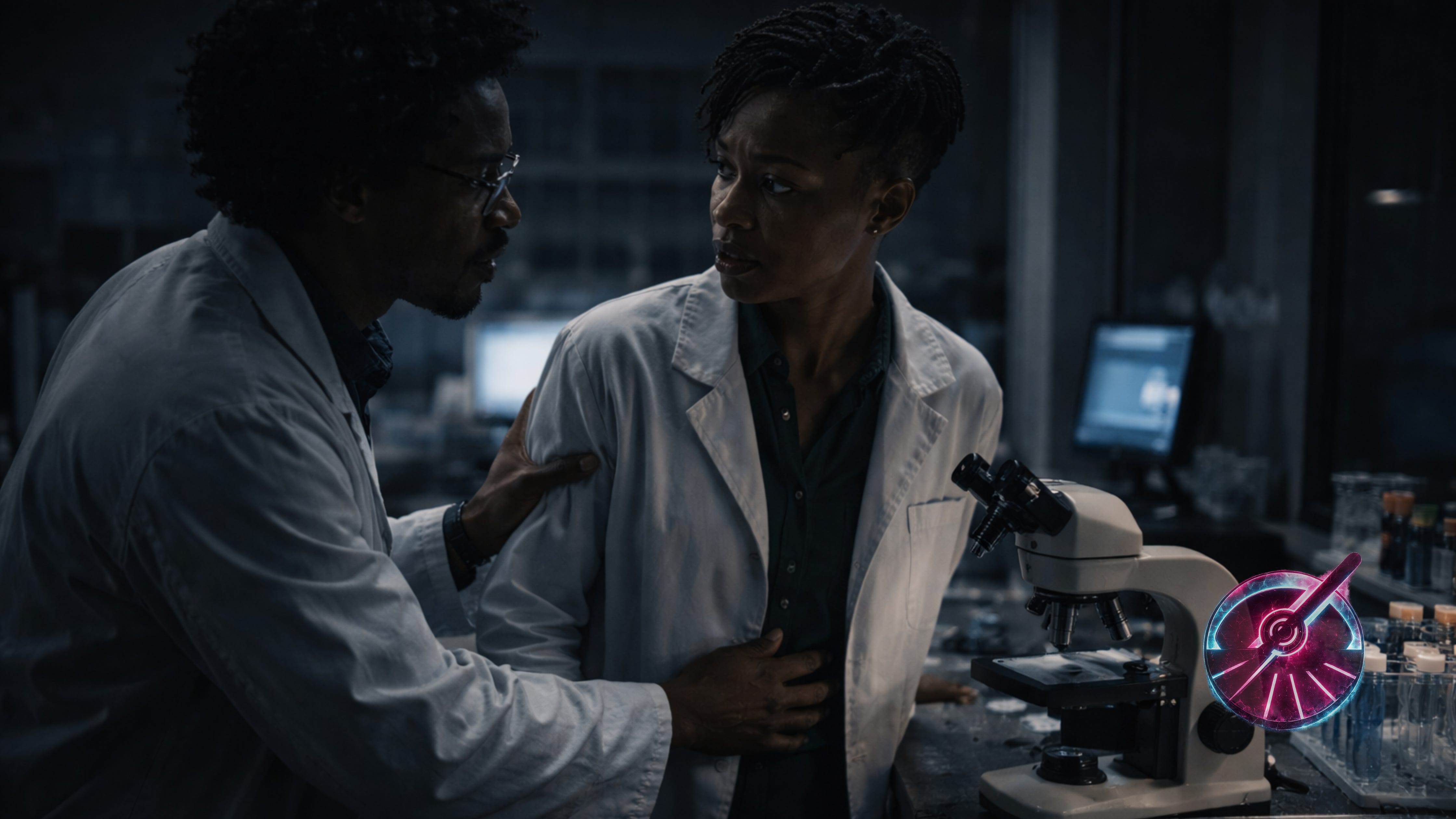
He guided her to the microscope like it was an altar. On the bench beside it: prepared slides, labeled vials, a small cold plate keeping samples stable. The lab smelled like ethanol wipes and burnt coffee—old work, no sleep.
“Just follow me,” he said. “I need your medical eye.”
“What? I quit pre-med to go into physics, remember? You’re the only MD on the team.”
“That doesn’t matter. This is basic,” he said, waving off the objection. “And you were acing pre-med. I saw something unusual. If you can see it too, then it’s not just me—or fatigue.”
“Okay…” she said, but the way she said it was a question.
He gave her the look that meant look.
“In here?” she asked, leaning toward the eyepiece.
“Yes. That’s my blood.” He paused before she put her eye down. “Before you look, remember: the way a body runs—blood flow, firing neurons, moving muscle, oxygen transport, how it recognizes pathogens—”
“Yeah,” she said, “it’s how the human body was m—”
“—designed,” he finished for her, and the word came out like it had weight.
She went still. “Okay…”
She humored him, peered into the microscope, and straightened.
“It looks normal to me, Jonathan.”
“Okay, okay.” He reached for another slide too quickly. The edge of his excitement made him look unsteady, like a man about to prove he wasn’t crazy by doing something that might get him arrested.
She caught his wrist. “Let me be honest with you. I think you’re exhausted. You’ve been here over seventy-two hours. Have you slept?”
He met her eyes. He didn’t want to worry her, but if anyone could hold what he was about to hand over, it was Lena. Also—he needed to rule out his own delirium.
“I don’t want to worry you,” he said, voice dropping. “But… please. Humor me a little longer.”
Lara exhaled and let him go. “Fine. Humor me.”
He swapped slides. She saw the label as it turned: the kind of label you don’t write unless you’re sure no one is coming through the door.
She bent again to the eyepiece—and jerked back so fast her chair scraped.
“What the hell did you do, Jonathan?” Her voice tightened. “You’re going to get in trouble for having these.”
He smiled for the first time that day—real, warm. The expression of a man who had finally found someone he could speak to without translating himself.
“It’s fine, Lena. The General gave me these nanites as a gift. I created them, after all, and I had ideas I wanted to test.”
“You asshole,” she said, but she was already leaning back toward the scope. “Why are you showing me these, Jonnie?”
He stilled at the name. She heard herself say it and colored. Silence thickened for half a breath, heavy with old history. Then he cleared his throat and nudged them back to the work, where the world was safer because it had rules.
“You remember the project,” he said. “Do you remember why we had to abandon it and create Homosynths?”
“Yes,” she said, grateful for the alley-oop. “We couldn’t get the nanites to play nicely with human tissue.”
“Right.” He all but jogged to a second bench. “That—other than this—has boggled me ever since.” He slid a new sample into place. “We found a workaround the General loved—synthetic humans with AI brains—but I never solved the original why.”
He leaned close, voice low. “If we can’t answer why, we can’t control the next iteration. That’s what’s been keeping me here.”
He nodded toward the eyepiece.
“Here. Look.”
Curiosity woke up fully now. Maybe he wasn’t spiraling.
She peered in and studied the pattern: membranes, nuclei, a familiar arrangement.
“A tissue sample?”
“Yep. Mine.” He swapped again, quick, practiced. “Now this.”
She didn’t ask; she just looked. She was too far down the rabbit hole to crawl backward.
“This is tissue from one of the Homosynths in the wild?” she asked, amused—and alarmed by how calm she sounded. “How’d you get this?”
“Another gift from the General,” he said. “After we mothballed the program, they put one into rotation in the Mine War.”
He readied a dropper—clear liquid in a small vial.
“You remember what happened when the nanites met human physiology, yes?”
“Yeah,” she said. “Our cells went combative and fought them off.”
“Exactly.”
He deposited two drops of liquid onto the slide. It wasn’t water. Thousands of nanites swam in suspension like a metallic snowfall, each speck a machine small enough to hide inside certainty.
Lara watched the human tissue mount its defense. It wasn’t dramatic in the way movies taught people to expect. It was swift. Chemical. Organized. The cells reacted like they recognized an intruder by silhouette, by signature, by something older than thought. The nanites clumped, stalled, then seemed to… lose cohesion. The sample looked briefly like a storm collapsing.
“I remember,” she said, lifting her head.
The day the results came back had gutted the team. Several never returned. She’d cried herself to sleep on Gillard’s couch after they split four bottles of wine. He’d stayed up, drunk and stubborn, and drafted the idea that became the Homosynth. He’d woken her with it, eyes wild, like he’d stolen fire and wanted credit.
“I never really asked the why,” he said softly.
“What why?”
“Why they didn’t sync to us. Why they fought.” He met her eyes. She could see it coming—the revelation angled to drop. “Until now.”
He swapped the human sample for the Homosynth again. He added the same nanite solution, careful, controlled, like he was placing a question mark on glass.
Then, with deliberate calm, he stepped back.
Lara hesitated. Curiosity and fear went to war in her chest. The nanites could eat the Synth cells. They could sync, creating something no one was ready for and shutting down the project in a heartbeat. Or nothing at all could happen, which would leave them with a different kind of ugly question: why the workaround existed at all.
She stared longer, breath shallow.
“They’re fighting…” she said, surprised by her own voice.
“It was a failsafe I programmed,” he said, palm warm and steady on her shoulder. “So no one—and nothing—could overwrite the code seated in Homosynth DNA.” He nodded toward the eyepiece. “Keep looking.”
The Homosynth cells didn’t behave like human cells, not exactly, but the logic was familiar. Recognition. Rejection. A defensive choreography. It wasn’t about “alive” versus “machine.” It was about permission. About what belonged inside the system and what didn’t.
Gillard’s excitement didn’t look like triumph anymore. It looked like dread that had learned how to speak in equations.
Then he did the part she didn’t expect him to do calmly.
He pricked his finger and let a drop of his own blood fall to the edge of the sample.
The red spread under the coverslip like a sunrise trapped in glass.
And the tableau erupted: Homosynth cells, human blood, and nanites all moving in the same violent grammar. The same kind of resistance. The same reflexive refusal.
Her inhale turned to a gasp. The pattern was unmistakable—recognition, then rejection, coded resistance firing like an immune memory, only deeper than immune. As if the tissue wasn’t just defending life, but defending authorship.
Gillard leaned close, voice lowered to something almost reverent—like he didn’t want the walls to hear.
“If I designed them not to be altered,” he said, the logic closing like a hinge, “who designed us not to be altered?”
The question sat between them and changed the air in the room.
Lena’s eyes stayed on the microscope, but she wasn’t seeing the slide anymore. She was seeing the implication—an invisible boundary drawn through every living thing, a line that said you may change, but only so far.
She swallowed, then asked the only honest question she had left.
“Jonathan… what are we?”
He didn’t answer.
He didn’t have to.
The sample did.
Wayfarer…
If your stomach tightened while you read—if the microscope felt like a confession booth, if the word failsafe suddenly sounded spiritual—you’re exactly where this story is meant to leave you.
Below is The Signal Layer (Author’s Notes): the bones beneath the lab—why “augmentation” becomes a boundary, why rejection reads like intent, and how Mythic Science turns a tissue slide into a universe-sized question. This is the lived nerve, the operational logic, and the craft gears that make the final line hit like a door clicking shut.
Thank you for reading. When you’re ready—step deeper.
